Syllabus Help Center
The class is composed of 9 Modules, each one of which covers a different signal processing topic. Each Module is subdivided into a varying number of smaller sub-modules between 10 and 20 minutes in length. In the following list, each module is followed (in brackets) by the corresponding chapter in the companion textbook.
-
Module 1: Introduction [Ch. 1]
- what is signal processing, some history and application examples
-
Module 2: Discrete-time (DT) signals [Ch. 2]
- basic examples
- the discrete-time complex exponential
- a simple sound synthesizer
-
Module 3: Euclid and Hilbert [Ch. 3]
- signal processing as geometry
- vectors spaces, bases, approximations
-
Module 4: Fourier Analysis [Ch. 4]
- the Discrete Fourier Transform (DFT)
- the Discrete-Time Fourier Transform (DTFT).
- examples.
- the Short-Time Fourier Transform
- the fast Fourier transform algorithm (FFT).
-
Module 5: Linear Filters [Ch. 5 and 6]
- linear time-invariant systems, convolution
- ideal and realizable filters
- filter design and implementation
- examples.
-
Module 6: Interpolation and Sampling [Ch. 9]
- continuous-time (CT) signals
- interpolation and sampling
- the sampling theorem as orthonormal basis expansion
- processing of CT signals in DT.
-
Module 7: Stochastic Signal Processing and Quantization [Ch. 8 and 10]
- stochastic signals
- quantization
- analog-to-digital (ADC) and digital-to-analog (DAC) conversion.
-
Module 8: Image Processing
- introduction to image processing and two-dimensional (2D) Fourier analysis
- filtering and compression
- the JPEG compression standard
-
Module 9: Digital Communication Systems [Ch. 12]
- analog channels and bandwidth/power constraints
- modulation and demodulation
- transmitter and receiver design
- ADSL.
Schedule
Each week, on Monday, we will release two lectures (and their associated homework) according to the following schedule:
- Week 1 (Oct 19)
- Module 1 (intro)
- Module 2
- Module 3
- Week 2 (Oct 26)
- Modules 4.1, 4.2, 4.3
- Modules 4.4, 4.5
- Week 3 (Nov 2)
- Modules 4.6, 4.7,
- Modules 4.8, 4.9
- Modules 4.6, 4.7,
- Week 4 (Nov 9)
- Modules 5.1, 5.2, 5.3
- Modules 5.4, 5.5, 5.6
- Week 5 (Nov 16)
- Modules 5.7, 5.8, 5.9
- Modules 5.10, 5.11, 5.12
- Week 6 (Nov 23)
- Module 6
- Week 7 (Nov 30)
- Module 7
- Week 8 (Dec 7)
- Module 8
- Week 9 (Dec 14)
- Module 9
Resources
Companion textbook
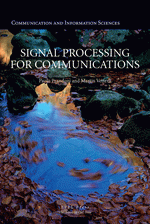
The class is based on the book "Signal Processing for Communications", by Paolo Prandoni and Martin Vetterli. The book is available for sale in printed form at major retailers. In the spirit of online teaching, you can of course download a copy of the book for free at www.sp4comm.org (and don't forget to mark your copy against the errata). A (paid) iBook version of this book is also available. Many more bibliographical references can be found in the textbook and additional handouts will be posted during the course.
Recommended background
Fundamentals of linear algebra and calculus are a must; familiarity with probability theory and system theory are highly recommended. Please take the self-assessment quiz we prepared in order to find your "weak spots" (if any) and take corrective action. Familiarity with Matlab (or similar applications) and/or scientific programming are a plus.
If you think you need some refresher course in any of the above prerequisites, the offer of online resources is quite vast these days. Let us give you some pointers to get started:
- For calculus and linear algebra, a nice set of online classes can be consulted on MITOpenCourseWare; likewise for probability theory.
- A good list of freely available mathematics textbooks can be found here.
- Here's a good introduction to probability theory in book form.
Last Modified Mon 30 Nov 2015 11:57 AM CET