

Seam-carving is a content-aware image resizing technique where the image is reduced in size by one
pixel of height (or width) at a time.
A vertical seam in an image is a path of pixels connected from the top to the bottom
with one pixel in each row.
(A horizontal seam is a path of pixels connected from the left to the right
with one pixel in each column.)
Below left is the original 505-by-287 pixel image; below right is the result after removing
150 vertical seams, resulting in a 30% narrower image.
Unlike standard content-agnostic resizing techniques (e.g. cropping and scaling), the most
interesting features (aspect ratio, set of objects present, etc.) of the image are preserved.
As you'll soon see, the underlying algorithm is quite simple and elegant. Despite this fact, this technique was not discovered until 2007 by Shai Avidan and Ariel Shamir. It is now a feature in Adobe Photoshop (thanks to a Princeton graduate student), as well as other popular computer graphics applications.
In this assignment, you will create a data type that resizes a W-by-H image using the seam-carving technique.
Finding and removing a seam involves three parts and a tiny bit of notation:
| (0, 0) | (1, 0) | (2, 0) |
| (0, 1) | (1, 1) | (2, 1) |
| (0, 2) | (1, 2) | (2, 2) |
| (0, 3) | (1, 3) | (2, 3) |
We also assume that the color of a pixel is represented in RGB space, using three integers between 0 and 255. This is consistent with the java.awt.Color data type.
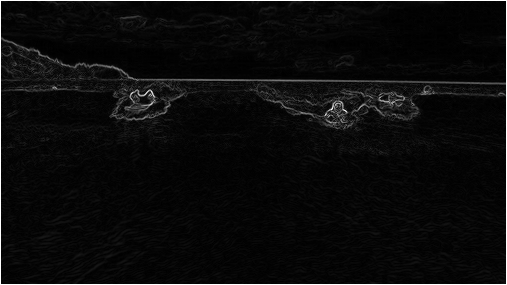
The energy is high (white) for pixels in the image where there is a rapid color gradient (such as the boundary between the sea and sky and the boundary between the surfing Josh Hug on the left and the ocean behind him). The seam-carving technique avoids removing such high-energy pixels.
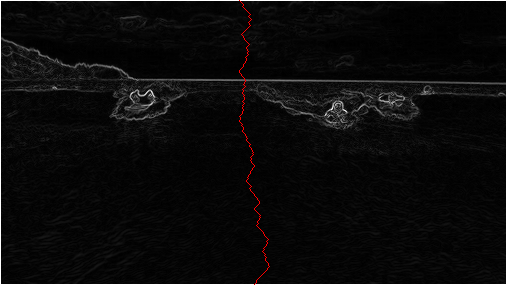
The SeamCarver API. Your task is to implement the following mutable data type:
public class SeamCarver {
   public SeamCarver(Picture picture)                // create a seam carver object based on the given picture
   public Picture picture()                          // current picture
   public     int width()                            // width of current picture
   public     int height()                           // height of current picture
   public  double energy(int x, int y)               // energy of pixel at column x and row y
   public   int[] findHorizontalSeam()               // sequence of indices for horizontal seam
   public   int[] findVerticalSeam()                 // sequence of indices for vertical seam
   public    void removeHorizontalSeam(int[] seam)   // remove horizontal seam from current picture
   public    void removeVerticalSeam(int[] seam)     // remove vertical seam from current picture
}
Corner cases. Your code should throw an exception when a constructor or method is called with an invalid argument, as documented below:
As an example, consider the 3-by-4 image (supplied as 3x4.png) with RGB values—each component is an integer between 0 and 255—as shown in the table below:
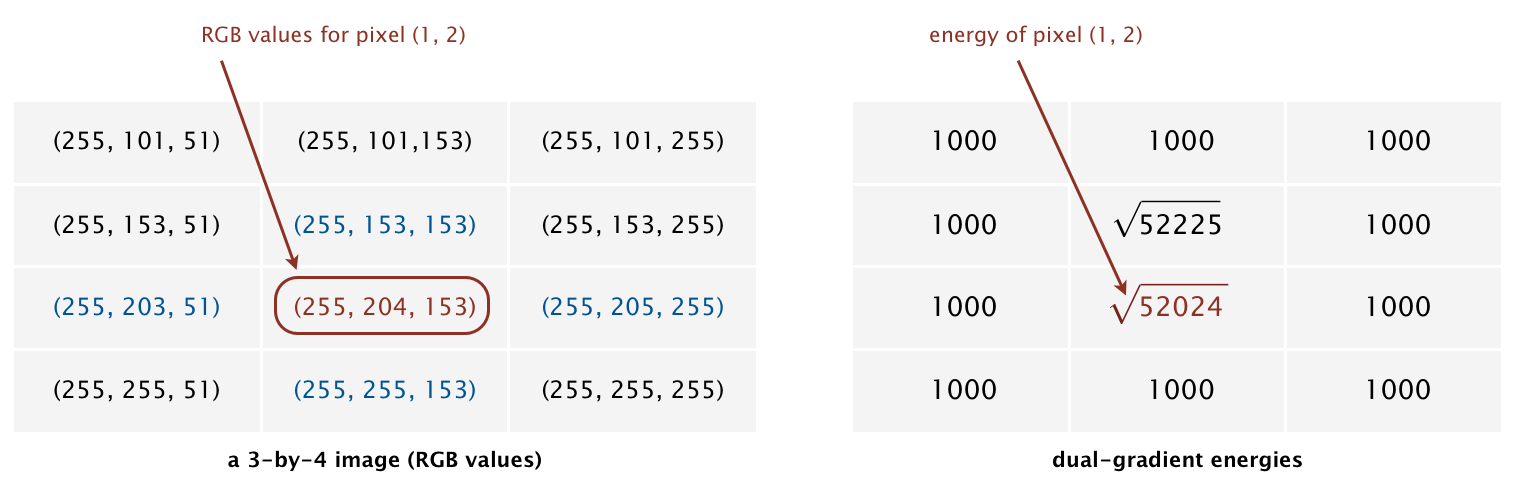
The ten border pixels have energy 1000. Only the pixels (1, 1) and (1, 2) are nontrivial. We calculate the energy of pixel (1, 2) in detail:
Rx(1, 2) = 255 − 255 = 0,
Gx(1, 2) = 205 − 203 = 2,
Bx(1, 2) = 255 − 51 = 204,
yielding Δx2(1, 2) = 22 + 2042 = 41620.
Ry(1, 2) = 255 − 255 = 0,
Gy(1, 2) = 255 − 153 = 102,
By(1, 2) = 153 − 153 = 0,
yielding Δy2(1, 2) = 1022 = 10404.
Thus, the energy of pixel (1, 2) is \(\sqrt{41620 + 10404} = \sqrt{52024}\).
Similarly, the energy of pixel (1, 1) is \(\sqrt{204^2 + 103^2}= \sqrt{52225}\).
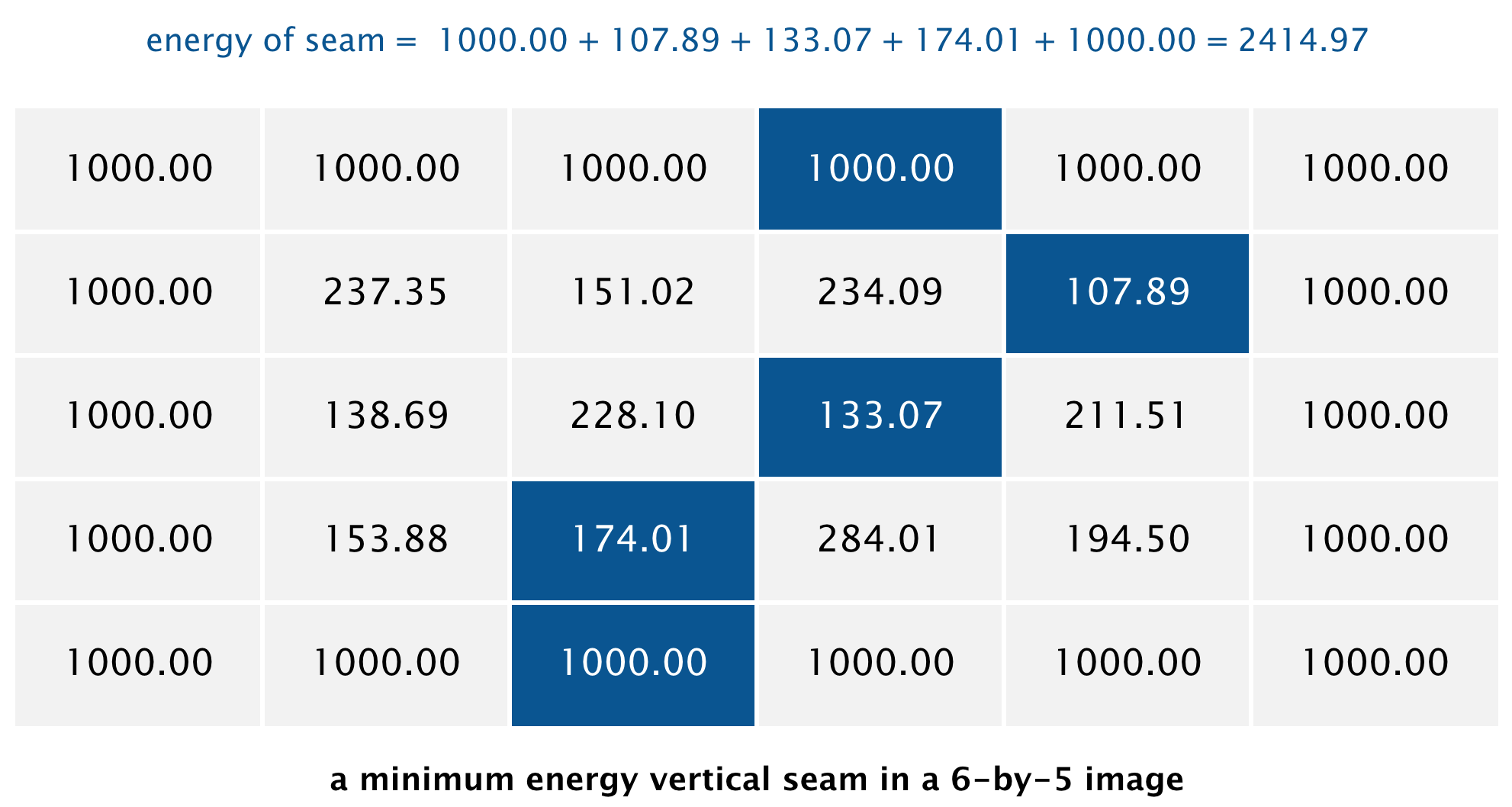
The minimum energy vertical seam is highlighted in blue. In this case, the method findVerticalSeam() returns the array { 3, 4, 3, 2, 2 } because the pixels in a minimum energy vertical seam are (3, 0), (4, 1), (3, 2), (2, 3), and (2, 4). When there are multiple vertical seams with minimal total energy, your method can return any such seam.
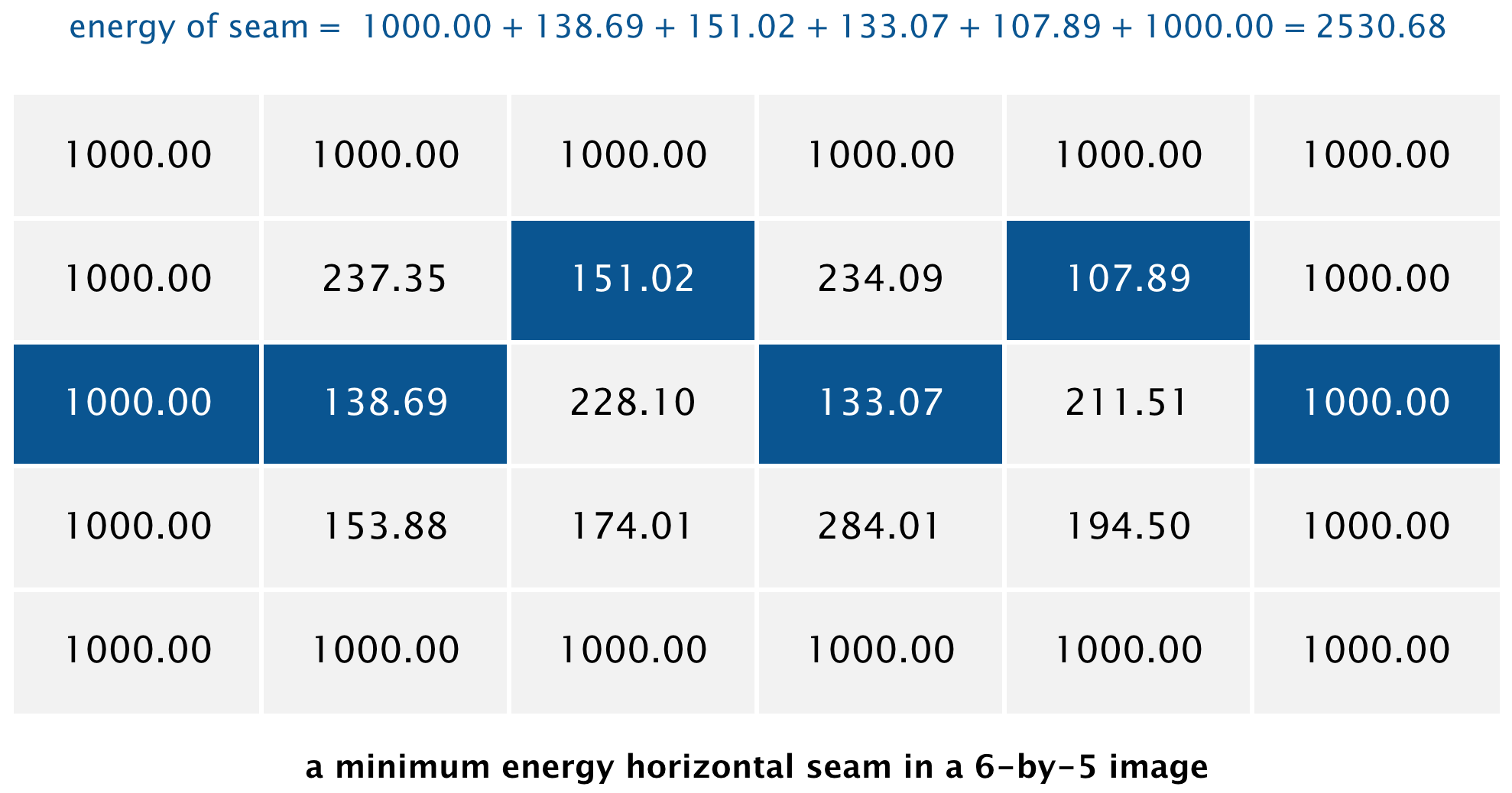
Finding a horizontal seam. The behavior of findHorizontalSeam() is analogous to that of findVerticalSeam() except that it returns an array of length W such that entry x is the row number of the pixel to be removed from column x of the image. For the 6-by-5 image, the method findHorizontalSeam() returns the array { 2, 2, 1, 2, 1, 2 } because the pixels in a minimum energy horizontal seam are (0, 2), (1, 2), (2, 1), (3, 2), (4, 1), and (5, 2).
Performance requirements. The width(), height(), and energy() methods should take constant time in the worst case. All other methods should run in time at most proportional to W H in the worst case. For faster performance, do not construct explicit DirectedEdge and EdgeWeightedDigraph objects.
Analysis of running time (optional and not graded).
Deliverables. Submit SeamCarver.java, and any other supporting files (excluding algs4.jar and SCUtility.java). You may not call any library functions other those in java.lang, java.util, java.awt.Color, and algs4.jar.
This assignment was developed by Josh Hug, Maia Ginsburg, and Kevin Wayne.

