Geometric primitives.
To get started, use the following geometric primitives for points and
axis-aligned rectangles in the plane.
Use the immutable data type Point2D (part of algs4.jar) for points in the plane. Here is the subset of its API that you may use:
public class Point2D implements Comparable<Point2D> {
   public Point2D(double x, double y)              // construct the point (x, y)
   public  double x()                              // x-coordinate
   public  double y()                              // y-coordinate
   public  double distanceTo(Point2D that)         // Euclidean distance between two points
   public  double distanceSquaredTo(Point2D that)  // square of Euclidean distance between two points
   public     int compareTo(Point2D that)          // for use in an ordered symbol table
   public boolean equals(Object that)              // does this point equal that object?
   public    void draw()                           // draw to standard draw
   public  String toString()                       // string representation
}
Use the immutable data type RectHV
(part of algs4.jar)
for axis-aligned rectangles.
Here is the subset of its API that you may use:
public class RectHV {
   public    RectHV(double xmin, double ymin,      // construct the rectangle [xmin, xmax] x [ymin, ymax]
                    double xmax, double ymax)      // throw a java.lang.IllegalArgumentException if (xmin > xmax) or (ymin > ymax)
   public  double xmin()                           // minimum x-coordinate of rectangle
   public  double ymin()                           // minimum y-coordinate of rectangle
   public  double xmax()                           // maximum x-coordinate of rectangle
   public  double ymax()                           // maximum y-coordinate of rectangle
   public boolean contains(Point2D p)              // does this rectangle contain the point p (either inside or on boundary)?
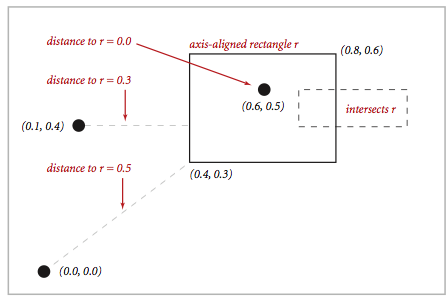
   public boolean intersects(RectHV that)          // does this rectangle intersect that rectangle (at one or more points)?
   public  double distanceTo(Point2D p)            // Euclidean distance from point p to closest point in rectangle
   public  double distanceSquaredTo(Point2D p)     // square of Euclidean distance from point p to closest point in rectangle
   public boolean equals(Object that)              // does this rectangle equal that object?
   public    void draw()                           // draw to standard draw
   public  String toString()                       // string representation
}
Do not modify these data types.
Brute-force implementation. Write a mutable data type PointSET.java that represents a set of points in the unit square. Implement the following API by using a red-black BST (using either SET from algs4.jar or java.util.TreeSet).
public class PointSET {
   public         PointSET()                               // construct an empty set of points
   public           boolean isEmpty()                      // is the set empty?
   public               int size()                         // number of points in the set
   public              void insert(Point2D p)              // add the point to the set (if it is not already in the set)
   public           boolean contains(Point2D p)            // does the set contain point p?
   public              void draw()                         // draw all points to standard draw
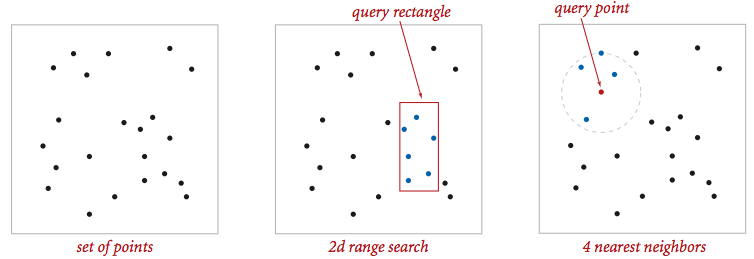
   public Iterable<Point2D> range(RectHV rect)             // all points that are inside the rectangle
   public           Point2D nearest(Point2D p)             // a nearest neighbor in the set to point p; null if the set is empty

   public static void main(String[] args)                  // unit testing of the methods (optional)
}
Corner cases.
Throw a java.lang.NullPointerException if any argument is null.
Performance requirements.
Your implementation should support insert() and contains() in time
proportional to the logarithm of the number of points in the set in the worst case; it should support
nearest() and range() in time proportional to the number of points in the set.
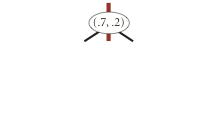
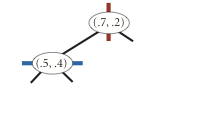
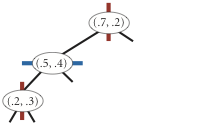
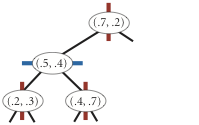
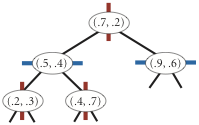
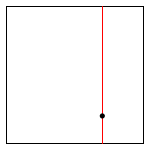
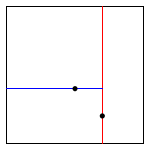
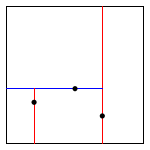
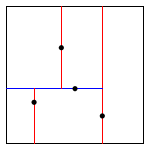
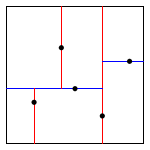
2d-tree implementation. Write a mutable data type KdTree.java that uses a 2d-tree to implement the same API (but replace PointSET with KdTree). A 2d-tree is a generalization of a BST to two-dimensional keys. The idea is to build a BST with points in the nodes, using the x- and y-coordinates of the points as keys in strictly alternating sequence.
insert (0.7, 0.2) insert (0.5, 0.4) insert (0.2, 0.3) insert (0.4, 0.7) insert (0.9, 0.6)
The prime advantage of a 2d-tree over a BST is that it supports efficient implementation of range search and nearest neighbor search. Each node corresponds to an axis-aligned rectangle in the unit square, which encloses all of the points in its subtree. The root corresponds to the unit square; the left and right children of the root corresponds to the two rectangles split by the x-coordinate of the point at the root; and so forth.
Clients. You may use the following interactive client programs to test and debug your code.
Analysis of running time and memory usage (optional and not graded).
Submission. Submit only the files PointSET.java and KdTree.java. We will supply algs4.jar. Your may not call library functions except those in those in java.lang, java.util, and algs4.jar.
This assignment was developed by Kevin Wayne.